Patently Absurd: Using AI to Over-Engineer a Cup of Warm Water
Published on
The Goldilocks Paradox of Bedtime Hydration
Sometimes the most complex technological solutions are born from the simplest, most trivial annoyances. In previous posts, I’ve used AI to fabricate an entire country music artist's career and hallucinated a ridiculously high-end Mayfair celery restaurant. This time, I decided to tackle a genuine, real-world problem: the profound difficulty of getting a comfortably warm mug of water before bed.
The conventional paradigm of boiling water and allowing it to passively cool relies on uncontrolled ambient thermodynamic decay (passive heat loss to the room), which is highly variable and entirely uncalibrated. Boiling water is an imprecise science, fraught with severe thermal hazards and profound health risks.
I didn't just want a theoretical idea for a better kettle; I wanted a fully articulated, rigorously documented device. I wanted to use AI to develop the information required to create a patentable invention, while also attempting to ensure it wasn't something someone could have done before so as not to infringe on any prior work.
Step 1: The Research Agent and the Physics of Thirst
To build something entirely novel, I first needed to understand the exact parameters of the problem. I deployed an AI deep research agent to investigate the clinical and thermodynamic imperatives of nocturnal hydration.
The agent returned some fascinating (and slightly terrifying) constraints. It turns out, orientating measurements indicate that a contact temperature exceeding 48°C becomes unbearable within seconds. Worse, epidemiological data unequivocally demonstrates that the chronic consumption of beverages at or above 65°C represents a risk factor for the development of esophageal squamous cell carcinoma (a specific type of throat cancer).
To resolve this precise physiological constraint, rigorous mathematical modeling combined with quantitative consumer preference metrics identifies 57.8°C as the theoretical optimum for hot beverage consumption.
Step 2: Architecting the "Micro-System"
Knowing the target was exactly 57.8°C, I tasked the AI with engineering a device capable of hitting this absolute optimum without risking the 65°C carcinogenic threshold, demanding that it abandon legacy systems. Achieving and subsequently maintaining this exact target temperature without subjecting the fluid to the unpredictable hysteresis (the delay or lag in a system's response to changes) of passive ambient cooling requires a radical departure from conventional appliance design.
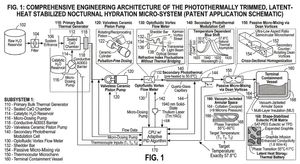
The result was the "Nocturnal Hydration Micro-System" - a highly advanced, multi-modal, opto-chemical microfluidic apparatus (a fancy, multi-step miniature smart-plumbing system). Here is how the AI decided we should heat a simple cup of water:
- Primary Bulk Thermal Generation: To rapidly elevate the temperature of the aqueous payload to a baseline of 50.0°C, the apparatus employs a mechanically modulated exothermic chemical reactor. This heating core leverages the highly exothermic hydration (a chemical reaction with water that gives off intense heat) of solid calcium oxide (quicklime).
- Precision Microfluidic Transport: To guarantee absolute flow stability, the fluid transport mechanism employs a valveless ceramic piston pump. By utilizing the physical geometry of the piston rather than compressing an elastic tube, it provides chemically inert, low-shear fluid metering (gentle, ultra-precise liquid measuring) that completely eliminates pulsation.
- Nanoscale Thermal Trimming: To elevate the temperature by the remaining 7.8°C with zero thermal inertia (lingering residual heat that causes the temperature to overshoot the target), the device abandons physical heating elements entirely, utilizing directed-energy photothermal conversion (turning light directly into heat). It uses a highly focused, solid-state Thulium (Tm:YAG) continuous-wave diode laser (a steady, continuous laser beam rather than a pulsing one) emitting precisely at the 1940 nm wavelength.
- The Natural Asymptote: This is where the AI's logic became genuinely brilliant. As the temperature of the liquid water increases, the hydrogen bond network (the weak magnetic connections holding water molecules together) begins to weaken. This structural relaxation causes the vibrational absorption peaks to undergo a distinct "blue shift" (a change in the specific wavelengths of light the water is capable of absorbing) toward shorter wavelengths. The water literally becomes less capable of absorbing the laser's energy as it approaches the target temperature. This dynamically dampens the heating curve, creating a natural thermal asymptote (a physical temperature ceiling) that physically resists pushing the fluid into the danger zone.
- Terminal Thermal Stabilization: Finally, the terminal containment vessel (the mug) is constructed utilizing Rigid Vacuum Insulated Pipe architecture (essentially an industrial-grade thermos flask). To actively stabilize the internal fluid, a passive thermal battery is embedded in the walls, utilizing an advanced organic-inorganic eutectic mixture (a specialized combination of materials engineered to melt and freeze at one very specific temperature) of Sodium Acetate Trihydrate (SAT) and Polyethylene Glycol (PEG).
Step 3: Visualising the Absurdity
With a brutally dense technical document in hand, I needed to make it look real. This was a much easier use of AI than my previous multi-agent pipelines. I simply distilled the relevant mechanical and architectural information into a concise prompt for Google's latest image generation model, Nano Banana 2.
After a few rapid iterations, Nano Banana 2 produced exactly what I needed: a remarkably convincing, highly complex patent application schematic (complete with detailed callouts for the "Optofluidic Vortex Flow Meter" and the "Passive Micro-Mixing via Dean Vortices") alongside a sleek, photorealistic product render that looks like it belongs in a high-end Mayfair boutique.
The Synthesis
The entire experiment was an exercise in scaling absurdity. By synthesizing the violent, grid-independent exothermic potential of quicklime hydration with the delicate, nanoliter-scale precision of a blue-shifting 1940 nm Thulium laser, the proposed apparatus transcends standard heating methodologies.
Am I actually going to build a bedside water cup that relies on industrial chemicals, optical metrology (light-based measuring), and mid-infrared lasers? Absolutely not. Aside from the fact that sourcing a research-grade Thulium laser, optofluidic sensors, and bespoke cryogenic vacuum piping would likely cost more than a small yacht - and completely ruin the bedside table aesthetic - I'm fairly certain my home insurance doesn't cover "accidental directed-energy discharge during nocturnal hydration."
But it highlights an incredible shift in the generative landscape. By chaining together a research agent, a bit of prompt distillation, and state-of-the-art image generation, it is now entirely possible to synthesise disparate, highly technical concepts into a coherent, visually striking, and mostly defensible piece of intellectual property in a single afternoon.